As Imperceptibly as Grief
Master Emily Dickinson's delicate exploration of loss in 'As Imperceptibly as Grief'. This guide unpacks her extended metaphor, structural mastery, and ambiguous tone to help you secure top marks in your GCSE Literature exam.
Study Notes
Overview
Emily Dickinson's 'As Imperceptibly as Grief' is a masterful exploration of gradual loss. Written in 1865 but published posthumously, the poem uses the subtle fading of summer into autumn as an extended metaphor for the quiet, almost unnoticed encroachment of grief. For GCSE examiners, this poem offers rich opportunities to demonstrate AO2 (analysis of writer's methods). Candidates who achieve top bands (Levels 5 and 6) move beyond simply stating that 'the poem is about death'; instead, they explore the ambivalence of the tone, noting how Dickinson balances serenity with melancholy. The poem's progressive structural shrinking—enacting the fading it describes—is a particularly fruitful area for high-level analysis.
Podcast Episode
Listen to this 10-minute deep dive into the poem's core concepts, exam tips, and a quick-fire recall quiz:
Plot/Content Overview
The poem does not have a narrative 'plot' in the traditional sense, but rather traces a chronological shift in nature and feeling:
- Stanza 1: The speaker introduces the central comparison: summer fading away is as imperceptible as the onset of grief.
- Stanza 2: The atmosphere becomes distilled and quiet, compared to a long twilight or an afternoon spent in isolation.
- Stanza 3: The light changes. Dusk arrives earlier, the morning feels foreign, and the warmth of the sun feels restrictive rather than liberating.
- Stanza 4: The final two lines offer a quiet, abrupt conclusion. The leaves forget to fall, and the transition is complete.
Themes
Theme 1: The Imperceptible Nature of Change and Loss
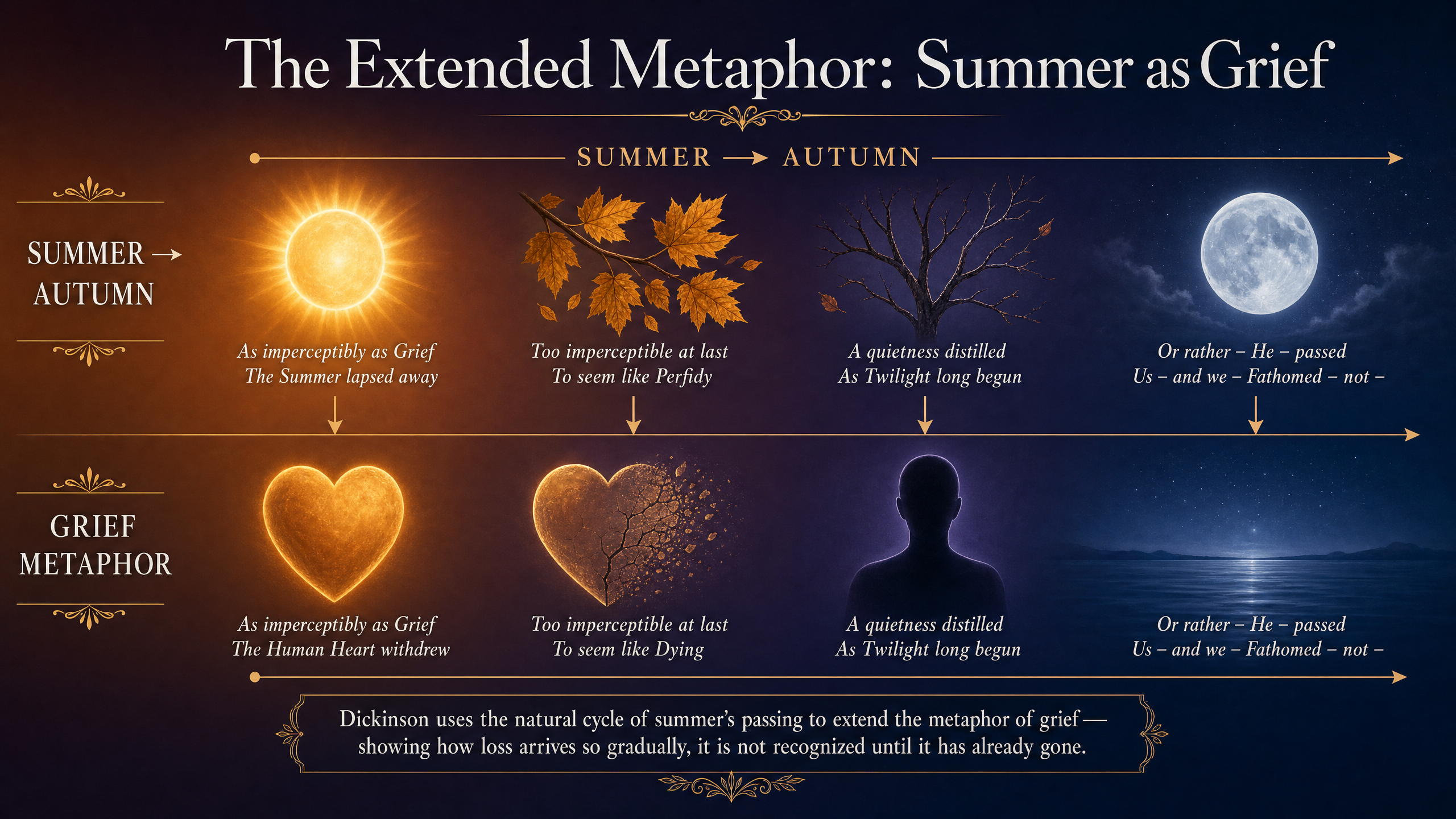
Dickinson presents loss not as a sudden, violent event, but as a slow, creeping process. The extended metaphor of seasonal change suggests that grief is a natural, inevitable part of human experience.
Key Quotes:
- "As imperceptibly as Grief / The Summer lapsed away" - The opening simile establishes the core comparison. The verb "lapsed" implies a quiet slipping away, like a loss of concentration or memory.
- "Too imperceptible at last / To seem like Perfidy" - The change is so gradual it cannot be considered a betrayal ("Perfidy"); it is simply the natural order.
Theme 2: Isolation and Withdrawal
The poem explores how grief isolates the individual, mirroring the way nature seems to withdraw into itself as autumn approaches.
Key Quotes:
- "A Quietness distilled" - The adjective "distilled" suggests something being concentrated and purified, pointing to the intense, focused nature of internal grief.
- "Or Nature spending with herself / Sequestered Afternoon" - The personification of nature as solitary and "Sequestered" (hidden away) reflects the isolation of the grieving mind.
Theme 3: The Ambivalence of Grief
Dickinson does not present grief as entirely negative. There is a strange beauty and serenity in the fading light, creating an ambiguous tone that balances peaceful acceptance with melancholy.
Key Quotes:
- "A Dusk drew earlier in — / The Morning foreign shone" - The light is still present but altered. The adjective "foreign" highlights the estranging effect of grief—the world looks the same but feels entirely different.
- "A Dungeon in the Sun" - This striking oxymoron captures the paradox of feeling trapped or isolated even in moments of apparent brightness or joy.
Writer's Methods
Form and Structure
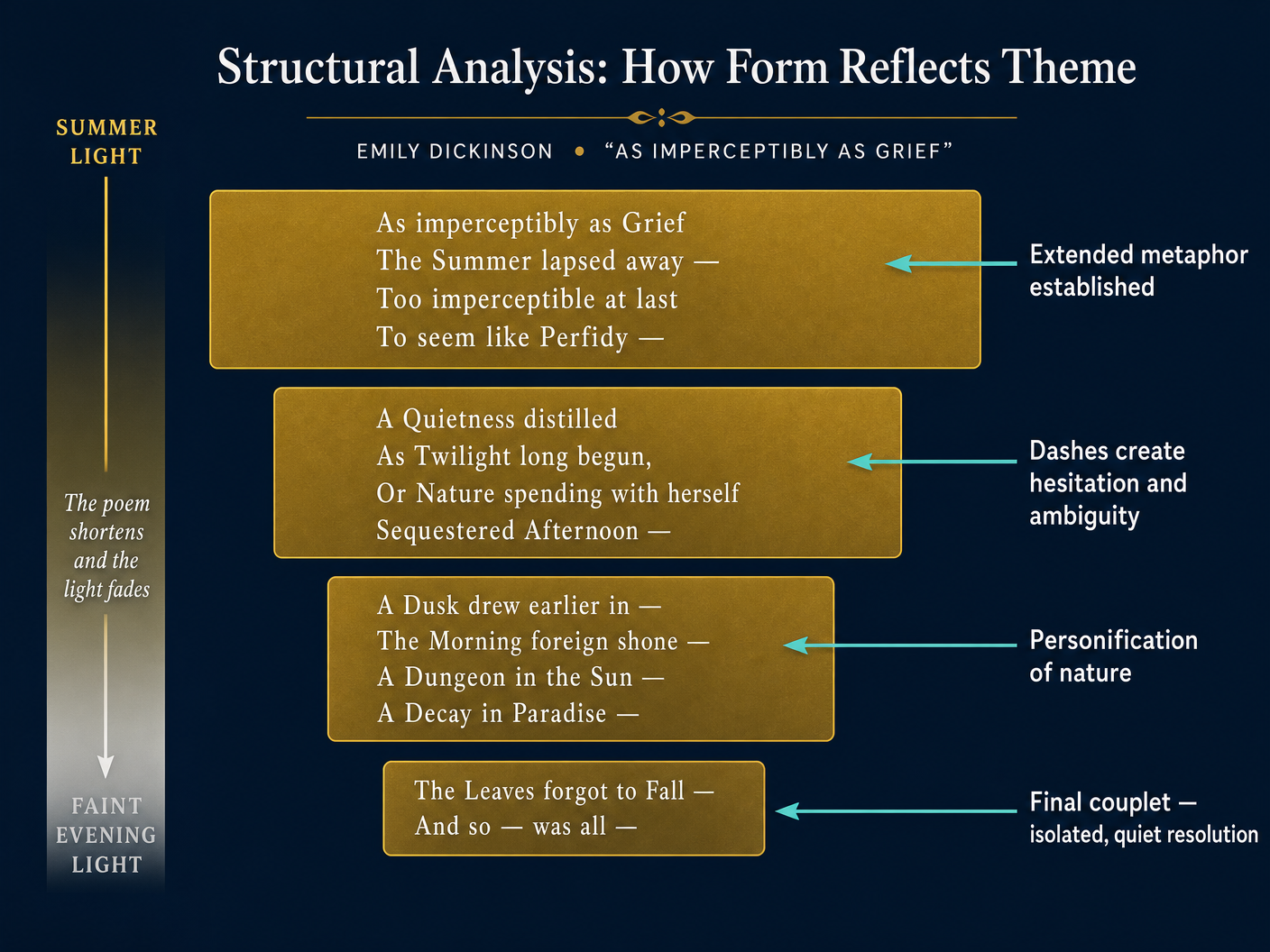
Dickinson's structural choices are central to the poem's meaning:
- Progressive Shortening: The poem consists of four stanzas. The first three are quatrains (four lines), but the final stanza is a couplet (two lines). This visual shrinking on the page enacts the fading of summer and the diminishing of light.
- Use of Dashes: Dickinson's characteristic dashes create pauses, hesitations, and silences. They slow the reader down, mimicking the slow, imperceptible nature of the change, and prevent the poem from reaching a neat, comfortable conclusion.
- Capitalisation: Dickinson capitalises nouns like "Grief", "Summer", "Quietness", and "Nature". This elevates these concepts, giving them weight and presence, almost personifying them as active forces.
Language and Imagery
- Extended Metaphor: The entire poem relies on the conceit that fading summer equals the onset of grief.
- Lexical Field of Fading Light: Words like "twilight", "Dusk", and "Afternoon" track the literal fading of the day and the metaphorical fading of joy.
Context
Emily Dickinson (1830–1886) lived a famously reclusive life in Amherst, Massachusetts. She rarely left her family home and observed the world—including the changing seasons—largely from her window. This physical isolation is reflected in the "Sequestered" imagery of the poem. Furthermore, 19th-century American society had a much more visible and present relationship with death and mourning than modern society. Dickinson's intense, inward focus and her preoccupation with mortality and the natural world are hallmarks of her work. Examiners reward candidates who use this context to illuminate the poem's themes of isolation and the naturalness of loss, rather than just bolting on biographical facts.
Visual Resources
2 diagrams and illustrations
Interactive Diagrams
1 interactive diagram to visualise key concepts
Conceptual Flow Outline
Thematic progression across the stanzas
Worked Examples
1 detailed example with solutions and examiner commentary
Practice Questions
Test your understanding — click to reveal model answers
Compare how Dickinson and one other poet present the passing of time.
Hint: Focus on the pace of time. Dickinson presents it as 'imperceptible' and slow. Does your chosen comparison poem present time as aggressive, sudden, or similarly slow?
Explore how Dickinson creates a sense of isolation in 'As Imperceptibly as Grief'.
Hint: Look closely at stanza 2 ('Sequestered') and stanza 3 ('foreign', 'Dungeon'). Link this to her structural use of dashes.
How does Dickinson use the natural world to explore human emotion?
Hint: This question requires you to unpack the extended metaphor. How does the fading of summer specifically relate to the feeling of grief?
Evaluate the view that the poem is entirely pessimistic about loss.
Hint: This is an evaluation question. You must argue against the statement. The poem is not 'entirely pessimistic'; it is ambivalent and contains moments of serenity.